| |
|
  
| |
|
|
|
|
Captured Pieces |
|
Captured Pieces |
|
|
 |
 Street View
 |
Captured Pieces |
|
Captured Pieces |
|
|
| |
|
|
We are asked often about how to design a "chess park", whether a
true park in the sense of a public recreation area that a city or campground
puts together or a private-sector area for an upscale home, resort, mall, or
hotel. This is where we have assembled some guidelines, lessons-learned, and
good ideas that we have collected over the years. Note that every situation is
different enough that the services of a qualified landscape architect to assess
your situation is always a good idea.
The layout diagram to the right shows some basic design goals.
Vary it to your situation, but keep these points in mind:
- Light Square The
near-right square as viewed by each player needs to be the light colored
square. This is rule #1 because of how often a chessboard gets redone because
of this. That little detail can be expensive.
- Side View People are
attracted to a chess game from a side view, particularly if the pieces are set
up to start a game (because that is how it is easiest to recognize). That is
why the street view shows the playing area from the side. If you are interested
in attracting passersby to your business or park, this is how to maximize a
giant chess set's amazing curb appeal. If you do not want that appeal (upscale
home wanting to keep its privacy), erect hedges or locate your chess park to
avoid its curb appeal.
- Seating Although people are
attracted to a chess game from the side, they prefer to settle in to watch the
game from either the top or bottom (in our diagram above), depending on which
player or side they find interesting. Staggered stadium benches at each end
allows them to see over one another and the giant chess pieces, so as to
understand and enjoy the game. For a televised or videotaped game, the
cameraman will prefer the highest vantage point at the two raised viewing
areas, alternating between the two depending on whose move it is.
-
Case Study Morro Bay, CA
One of the pioneers of chess parks in the USA,
read about some things done well and
some not. |
Bench Each players will
need a bench to sit and think after they make their move. To leverage the
theme, place a plank across the top of two rooks (and you then also have spare
rooks).
- Tile Board The most
common material for permanent outdoor chessboards is colored tile squares as
found at any building supply store. Although black & white or red &
white are the most popular, any contrasting dark/light combination is allowed.
An off-white and an off-black remains clean looking longer. The procedure is
the same as laying outdoor floor tile. For high traffic areas or to avoid
slippery tile, use concrete with an acid etch to form the checkerboard.
- Painted Board To save
money, schools should just paint the checker board on the playground asphalt
near the utility closet where the pieces will be stored. Use a measured chalk
line, and just use a steady hand with a brush. Templates seem to always have a
dripping edge where the paint runs underneath and you see it only when you lift
it. Also, people often smear the paint when lifting a template that big. And a
tiny wave in the paint edge is only noticeable close up when you paint, not
when you stand above it.
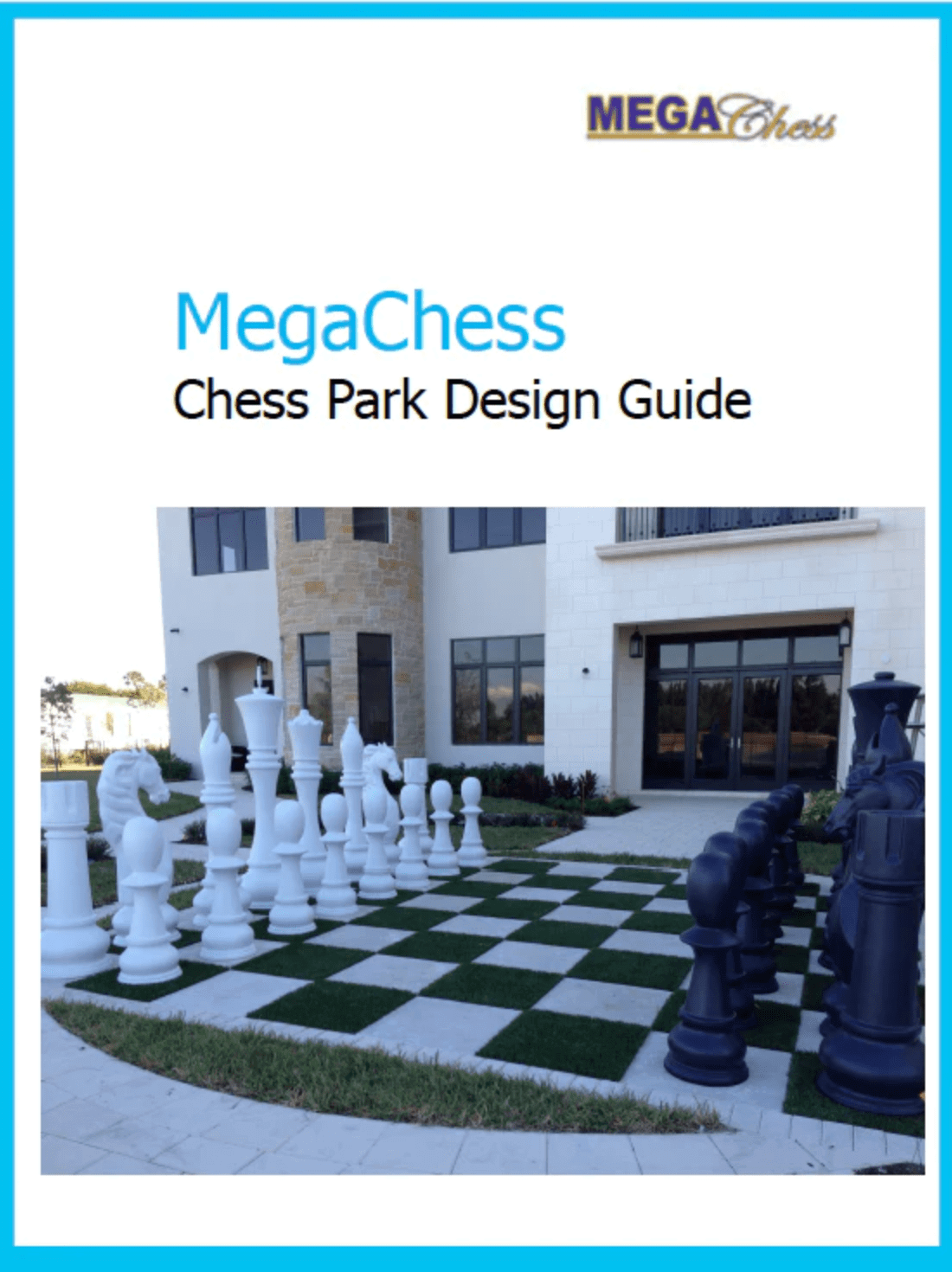
Lawn Board
An innovative outdoor chessboard where a lawn can grow is a chessboard made of
alternating grass squares. Simply lay square pavers or stepping stones in a
pattern leaving the grass as the alternating color as shown at right. This can
be laid directly on somewhat flat ground or existing lawn without the leveling
needed for tile. Add dirt between the pavers if you wish. Because there is no
edge-to-edge contact between tiles, slight surface variations are not
noticeable. It is also quite cheap and more portable than a chessboard
involving concrete or mortar.
- Planter Board The
cheapskate's version of the lawn board above uses empty planter trays. You'll
find those next to the dumpster of your neighborhood garden nursery, or their
landscape contracting customers. Empty, they're just tossed away (even though
they should be recycled). Flip 32 of them edge down on your lawn like the
pavers of the lawn board above. Eventually, the edges dig in and they'll stop
moving. There's maintenance as the grass tries to grow up through them, but you
can't beat the price.
Board Labeling For chess
tournaments or to learn chess, you should label the board with chess notation.
When following a chess game from a book, for example, it may direct the pawn
from d2 to d4. Note how the designation letters facing the white player go from
A to H and from 8 down to 1, while facing black it goes H to A and 1 down to 8.
This is so everyone talks about the same square no matter which side they're
on.
- Nearby Tables Provide
nearby opportunities to play regular-sized chess, typically tables with
chessboards inlaid or painted. This gives chess park visitors something to do
while they wait their turn at the giant chess set. It also acts as a draw to
chess clubs and tournaments which would make the giant chess set a focus if
they could play their other chess games at the same time.
- Security Security is an
important consideration. Besides garden-variety vandals, there are also thieves
looking to place stolen decor around their homes. The street view in the above
diagram should be fenced from busy public streets. Pieces should be stored at
night. Depending on the neighborhood, topiary chess
sets can be left out with a long length of bicycle cable looped through
their frames. The emerging field of embedded RFID devices offers a
cost-effective way to keep pieces from disappearing.
- Set Sizes Choices for
chess set sizes vary by visual impact desired (the bigger the better), the
cost, and the ability of players to lift the pieces. A chess set where the king
is 2-foot tall is the most popular because that marks the transition from the
table top set. Anything smaller is out of place on the ground. A set where the
king is 3-foot tall appears much larger than the 2-foot set. A set with the
4-foot king makes a memorable impression. A set where the king is 6-foot tall
is only for the outlandish. If many of the players will be kids or those of
retirement age, stick with a set where the queen is no heavier than 20 lbs. The
king isn't as important because he moves only one square and can be rolled into
an adjacent square.
- Referees For refereed
games, set up a temporary table in the middle of the area with the "Street
View" arrows above. Although the other side of the mid-board is acceptable, it
increases the distance to the storage areas for this rare occasion.
- Storage Make storage large
enough to store a high-end chess set for adults, the one that looks great for
photo opportunities, tournaments, etc. and room for another cheap,
indestructible, light-weight chess set for kids like the injection-molded version. Assume kids will come around no
matter how insulated you think you are -- they are attracted to giant chess
like flies. Have a portable chessboard available
so you can banish them if the adults want to enjoy
a serious game. And provide a third storage area for a giant checker set.
Segment them with three doorways. No need to make them waterproof.
To
calculate storage space, consider the arrangement of the pieces to the right as
the tightest practical for stacking without special brackets. Avoid such
brackets. Pieces get dropped, backs get pulled, fingers get pinched. Store the
pieces and retrieve the pieces with straight lifts, where the person's back
remains erect at all times -- not so they have to twist and lean over
 Stacked
Pawns |
lawn mowers, chairs, etc. In the arrangement to the
right, the bishops stack on the rooks. Cross the pawns to stack them as shown
at left. The pawn stack should be leaned against a wall, best in a corner, or
against another stack of pawns, perhaps from the other color. Mark an outline
on the storage shed's walls where the pieces go. This also alerts people
immediately if they have a missing piece.
The 61" wide x 58" tall x 27"
tall storage space (55.3 cu.ft) is for a traditional Staunton chess design
where the king is 48 inches tall. Note that it is for
half (one color) of a chess set. For a set with a 24" king, halve all
dimensions. Other dimensions are proportional. If you are trying to fit in a
tighter space, raise by 4 inches the floor where you set the king, queen and
knights. This allows their bases to overlap the pieces behind them and you can
knock 15% off the depth (27" to 23" in the above picture). For the
light plastic chess set for the kids, simply toss them in a
MegaBag and let the kids drag them around, or provide
a wagon.
- Extra Pieces Order
extra pieces to use as decorations. Anchor them to pedestals or bollards,
either around the corners of the chess park for ambiance, or in lobbies and
remote locations with arrows pointing toward the chess park. For malls,
synergistic destinations like toy stores and cafes can put a chess piece in the
window to connect to chess park visitors. These can be replacement pieces for
the chess park set if its pieces are lost or broken.
Have some tips of your own? Let us
know and we'll add it to the list.
Still have questions? Use our Ask
the Expert form and we'll route it to someone with experience. |
|
|